
Categorías
Nuevo blog
LoRaWAN Integrated Potassium Ion Sensor Selection Guide: How to Choose the Right Water Quality Monitoring Equipment
April 21 , 2026
In water quality monitoring projects, potassium ion concentration is a critical indicator in agriculture, environmental protection, industry, and other fields. With a wide range of sensors available on the market, how do you make the right selection? Based on the technical features of the LoRaWAN integrated potassium ion transmitter, this article summarizes the key selection points for you.
The first step in selection is to confirm the potassium ion concentration range of the water body under test. The LW114D offers two measuring ranges: 0~100.00 mg/L (resolution 0.01 mg/L) and 0~1000.0 mg/L (resolution 0.1 mg/L), with the 1000 mg/L range set as default. A lower range is more suitable for drinking water and surface water monitoring, while a higher range is required for industrial wastewater and high-concentration nutrient solutions.
In terms of accuracy, the sensor provides ±10% of reading or ±1 mg/L (whichever is greater), and features a built-in Pt1000 automatic temperature compensation with an accuracy of ±0.5℃. This accuracy level is sufficient for most agricultural and environmental monitoring scenarios. For applications demanding higher precision, regular calibration or laboratory-grade instruments can be considered.
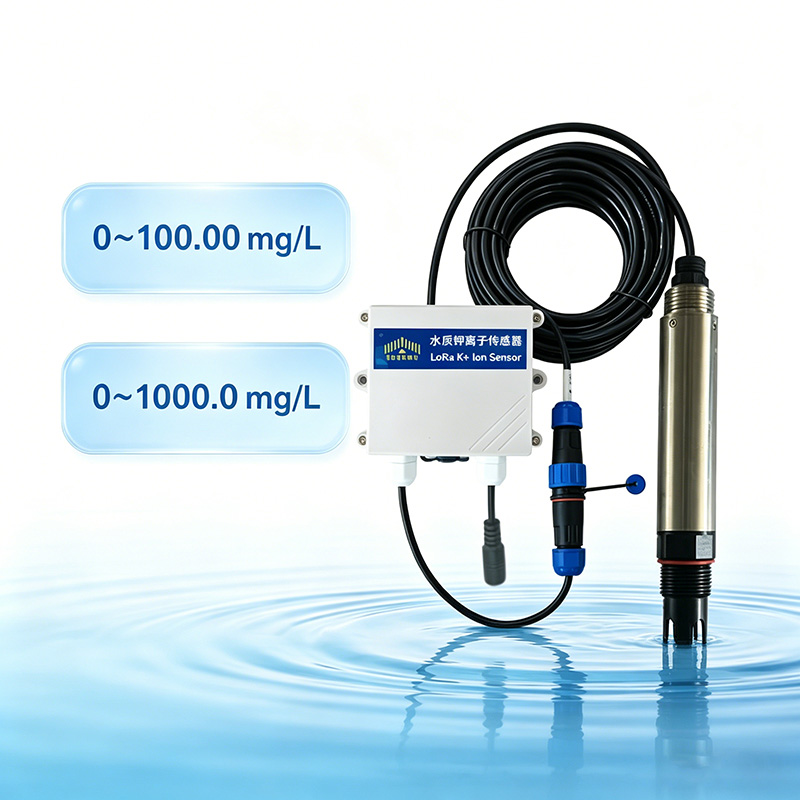
Wireless transmission is a major challenge for outdoor monitoring. The LW114D supports mainstream global LoRaWAN frequency bands including CN470, EU868, and US915, and is compatible with OTAA activation and Class A/C operating modes. This enables long-distance data transmission to cloud platforms via LoRaWAN gateways in farmlands, rivers, fish ponds, and other areas without 4G coverage.
During selection, verify whether LoRaWAN gateway coverage is available on-site and whether self-organizing networking is needed. The default data reporting interval is 10 minutes (adjustable from 1 to 65535 seconds), with low power consumption suitable for battery-powered applications. In addition, the standard electrode cable length is 5 meters (customizable). During installation, the electrode must not be placed upside down or horizontally; it should be tilted at an angle of at least 15° to ensure accurate measurement.
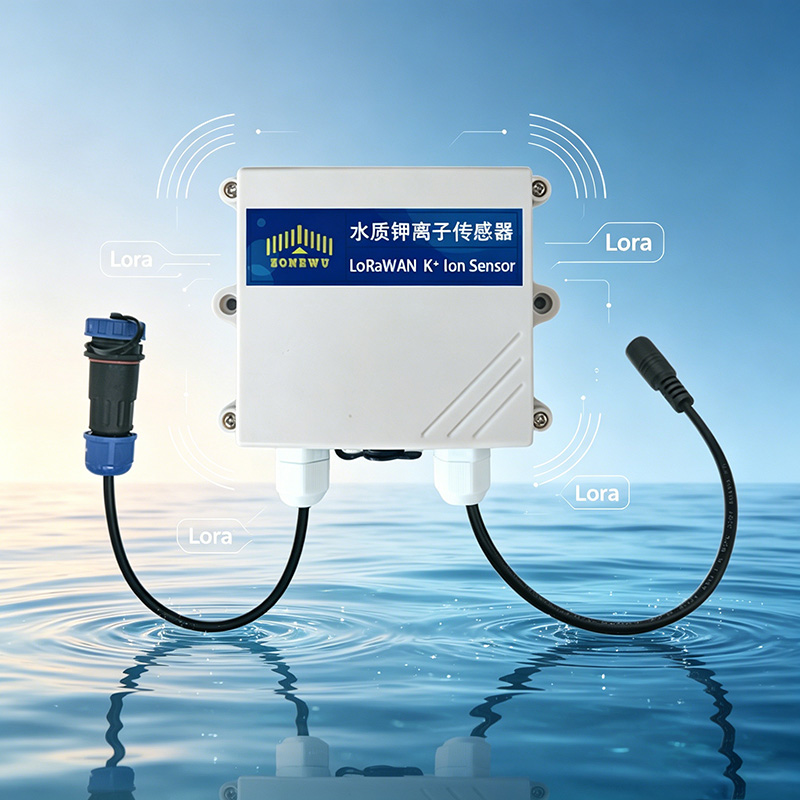
The sensor operates under conditions of 0~40℃, <0.1 MPa, and pH 4~10. The main interfering ions for the potassium ion electrode are Cs⁺ and NH₄⁺, with a wide effective pH range of 2~12. In practical selection, cross-interference should be evaluated if the water body contains high concentrations of ammonium ions. Interference tables for other ion electrodes are also provided in the documentation to facilitate multi-parameter selection.
With an IP68 protection rating, the electrode has a service life of 1 to 2 years. When not in use for long periods, it should be stored dry with the protective cap securely fitted.
The sensor is calibrated at the factory, eliminating the need for frequent user calibration. If deviations occur, zero-point, slope, and three-point temperature calibration can be performed via downlink commands. It supports remote calibration through LoRaWAN downlink commands without on-site disassembly and assembly. Routine maintenance only requires checking dryness of the wiring terminals and regular cleaning of the electrode with deionized water.

Tel : +86 18146178586
Whatsapp : +86 18146178586
Correo electrónico : qui@zonewu.com
agregar : 1501-3, Building F03, Phase III, Software Park, Jimei District, Xiamen City, Fujian Province, China